

Comparing Single-Screw and Twin-Screw Plastic Extruders for Manufacturing
I believe the best plastist ekstruuder for your operation depends on your product goals and the materials you process. I see that single-screw extruders offer versatility and straightforward operation, while twin-screw designs provide precise mixing and consistent output. Näiteks, recent engineering studies show that twin-screw extruders deliver more uniform plasticizing and better mixing control than single-screw machines:
| Aspekt | Üks kruvi | Kaksikkruvi |
|---|---|---|
| Conveying and Plasticizing | Dependent on material’s frictional properties; poorer plasticizing uniformity. | Positive displacement ensures consistent conveying; more uniform plasticizing. |
| Mixing and Dispersing | Ei sobi suureks homogeniseerimiseks; requires mixing elements for improvement. | Excellent mixing control; ideal for compounding and modification. |
| Eluaja jaotus | Laiem levik; halva plastifitseerimise või termilise lagunemise oht. | Kitsas levik; Kuumatundlike materjalide ühtne töötlemislugu. |
Monditechi täiustatud plastist ekstruudermasina tehnoloogia toetab selliseid tööstusharusid nagu autotööstus, ehitus, ja pakendamine. Optimaalsete tulemuste saavutamiseks sobitan ekstruuderi tüübi alati tootmisnõuetega.
Võtmed kaasavõtmiseks
- Ühe kruviga ekstruuderid on mitmekülgsed ja sobivad ideaalselt lihtsate ülesannete jaoks, muutes need sobivaks põhiliste tootmisvajaduste jaoks.
- Kahe kruviga ekstruuderid on suurepärased keerukate materjalide segamisel ja töötlemisel, pakkudes suurepärast kvaliteeti ja järjepidevust.
- Võtke arvesse konkreetseid tootmisnõudeid, nagu materjalitüübid ja soovitud väljund, ekstruuderitüüpide vahel valides.
- Kahe kruviga ekstruuderid pakuvad paremat energiatõhusust ja madalamaid kasutuskulusid, muutes need nutikaks pikaajaliseks investeeringuks.
- Regular maintenance and quality assurance are crucial for maximizing the performance and lifespan of any extruder.
- Evaluate the total cost of ownership, including energy and maintenance, mitte ainult esialgne ostuhind.
- Involve production and maintenance teams early in the selection process to ensure the chosen extruder meets all operational needs.
- Consult with experts, like those at Monditech, to avoid common mistakes and make informed decisions about extrusion technology.
Plastic Extruder Technical Differences
Single-Screw Extruder Operation
Principle and Features
I see the single-screw extruder as the foundation of many plastist ekstrusioon processes. This machine operates on a straightforward principle. The screw rotates inside a heated barrel, moving plastic resin forward. As the resin travels, the temperature rises, and the material melts. Enamik sulamist toimub tünni seina lähedal, kus soojusülekanne on kõige tõhusam. Kruvi pöörlemine tekitab hõõrdumist ja survet, mis aitavad vaiku sulatada ja segada. Pööran suurt tähelepanu sellele kruvi temperatuur, libisemiskiirus, ja survet, kuna need tegurid kontrollivad sulamiskiirust ja lõpptoote kvaliteeti.
Monditechi ühe kruviga ekstruuderi tehnoloogia paistab silma oma täpse temperatuurijuhtimise ja tugeva kruvikonstruktsiooni poolest. Need omadused tagavad tahkete ainete ühtlase edasiandmise ja tõhusa sulamise. Toetun sellele tehnoloogiale lihtsust ja töökindlust nõudvate rakenduste puhul. Ühe kruviga ekstruuder töötab kõige paremini lihtsate valemite ja standardsete materjalidega, muutes selle mitmekülgseks valikuks paljudele tootmisliinidele.
Põhikomponendid
Kui ma uurin ühe kruviga ekstruuderit, I focus on several essential parts:
- Punker: This is where I load the raw plastic material.
- Kruvi: The heart of the machine, responsible for moving, sulamine, and mixing the resin.
- Tünn: A heated chamber that surrounds the screw and provides the necessary temperature for melting.
- Heaters and Temperature Controls: These maintain the optimal processing temperature.
- Surma: This shapes the melted plastic into the desired profile, such as pipes or sheets.
- Drive Motor: Powers the screw’s rotation.
I appreciate the simplicity of this design. It allows for easy maintenance and quick cleaning, which reduces downtime and keeps production running smoothly.
Twin-Screw Extruder Operation
Intermeshing vs. Non-Intermeshing
The twin-screw extruder introduces a new level of control and flexibility to plastic extrusion. I can choose between intermeshing and non-intermeshing screw configurations. Intermeshing screws fit together like gears, creating a self-wiping action that prevents material buildup. This design ensures efficient mixing and consistent material flow. Non-intermeshing screws operate independently, which I use for specialized applications that require gentle handling of sensitive materials.
Unique Capabilities
I turn to the twin-screw extruder when I need advanced processing capabilities. This machine uses two screws that rotate together, generating high shear forces. These forces guarantee uniform dispersion of additives and fillers, which is critical for producing high-quality compounds. The self-wiping action keeps the barrel clean and minimizes downtime. I also benefit from the energy-efficient design, which lowers operational costs.
Monditech’s twin-screw extruder technology gives me the flexibility to handle a wide range of materials and formulations. I can produce 30-50 different masterbatch types, compared to only 10-15 with a single-screw system. This expanded range means I can meet more customer needs and reduce product returns. The rapid payback period and high return on investment make this technology a smart choice for manufacturers who demand both quality and efficiency.
Technical Comparison Table
I often use a comparison table to highlight the technical differences between single-screw and twin-screw extruders:
| Funktsioon | Ühe kruviga ekstruuder | Kahe kruviga ekstruuder |
|---|---|---|
| Number of Screws | One rotating screw | Two intermeshing or parallel screws |
| Segamise efektiivsus | Põhiline segamine, suitable for simple formulas | Suurepärane segamine, ideal for complex compounding |
| Materjalikäitlus | Limited adaptability | Handles a wide variety of materials |
| Läbilaskevõime | Madalam, best for small to medium production | Kõrgem, supports large-scale manufacturing |
| Toote kvaliteet | Muutuv, depends on material properties | Järjepidev, high-quality output |
| Hooldus | Lihtne, easy to clean | Keerulisem, often self-cleaning |
| Paindlikkus | Piiratud, best for standard products | Väga paindlik, supports many formulations |
| Energiakasutus | Generally higher per output | Tõhusam, lower operational costs |
Vihje: I always match the extruder type to the production requirement. This ensures I achieve the best balance of quality, tõhusust, and cost for each project.
Key Terms Explained
When I work with plastic extruders, I rely on a set of core technical terms. Understanding these terms helps me communicate clearly with engineers, operators, and decision-makers. Here are the key concepts I use every day:
- Ekstruuder
I define an extruder as a mechanical apparatus that presses material through a die. This process creates a continuous product with a uniform cross-section. Minu kogemuse järgi, extruders form the backbone of many manufacturing lines. - Kruvi
The screw sits at the heart of the extruder. It rotates inside the barrel, moving raw plastic forward. The screw’s design determines how efficiently I can melt, segada, and convey material. - Tünn
The barrel surrounds the screw and provides the heated environment needed for plastic transformation. I monitor barrel temperature closely to ensure consistent melting and product quality. - Drive System
The drive system powers the screw’s rotation. I depend on a reliable drive to maintain steady throughput and avoid production interruptions. - Surma
The die shapes the melted plastic as it exits the extruder. By changing the die, I can produce pipes, linad, filmid, or custom profiles. - Material Transport
This term refers to the movement of plastic pellets or powder through the extruder. Efficient material transport ensures smooth operation and high output. - Material Transformation
I use this term to describe the melting and mixing of raw plastic inside the extruder. Proper transformation is essential for achieving the desired product properties. - Forming
Forming happens when the melted plastic passes through the die and takes on its final shape. I adjust process parameters to ensure precise forming and minimal waste. - Ühe kruviga ekstruuder
This type of extruder uses one rotating screw. I choose single-screw machines for straightforward processing tasks and standard materials. - Kahe kruviga ekstruuder
Twin-screw extruders use two screws, either intermeshing or parallel. I rely on these machines for advanced mixing, liitmine, ja erirakendused. - Ram Extruder
Although less common in plastics, a ram extruder uses a piston to push material through the die. I see this design more often in laboratory or specialty settings.
Märkus: I find these terms essential for understanding how Monditech’s plastic extruders deliver reliable performance across industries like automotive, ehitus, ja pakendamine. Mastering this vocabulary helps me make informed decisions and optimize every stage of the extrusion process.
Best Applications
Single-Screw Extruder Uses
Levinud tooted
I rely on the single-screw extruder for many standard manufacturing tasks. In the automotive industry, Tootan sageli tihendid, tihendid, and trim profiles. These parts play a crucial role in preventing leaks, supporting engine assemblies, and adding both decorative and functional features to vehicles. I see similar demand in construction, where single-screw extruders create pipes, kanalid, and basic fittings. In packaging, I use this plastic extruder machine to manufacture simple films and sheets. Lihtne töö muudab selle ideaalseks igapäevaste esemete suuremahuliseks tootmiseks.
- Tihendid lekke vältimiseks
- Tihendid mootoritele ja sõlmedele
- Trimmiprofiilid sõidukite sise- ja välispindade jaoks
Samuti kasutan ühe kruviga ekstruudereid plasti taaskasutusprojektides. Masin käsitleb tõhusalt otse lihvimismaterjale, võimaldades mul muuta plastijäätmed uuteks toodeteks. See võimalus toetab jätkusuutlikku tootmist ja vähendab materjalikulusid.
Materjalide ühilduvus
Ühe kruviga ekstruuderi valin siis, kui mul on vaja töödelda mitmesuguseid materjale. Hiljutised materjaliteaduse uuringud näitavad, et see masin töötab hästi suure jõudlusega polümeerid, kiududega tugevdatud komposiidid, elastomeerid, ja materjalid otse uuesti lihvima. Tootmiseks materjalide valimisel viitan sageli järgmisele tabelile:
| Materjali tüüp |
|---|
| Suure jõudlusega polümeerid |
| Kiudtugevdatud komposiidid |
| Elastomeerid |
| Materjalide otsene lihvimine |
This compatibility allows me to support recycling initiatives and produce complex profiles for various industries. I find that the single-screw extruder delivers reliable results with basic thermoplastics and fillers, making it a versatile choice for many applications.
Twin-Screw Extruder Uses
Segamine ja segamine
I turn to the twin-screw extruder when I need advanced mixing and blending capabilities. This machine excels at compounding thermoplastic materials, melting and shaping plastics, and producing films and sheets for packaging. I often use it to manufacture plastic products for consumer goods and packaging, where consistent quality and precise formulation are essential.
- Compounding thermoplastic materials
- Melting and shaping plastics
- Production of films and sheets for packaging
- Plasttoodete tootmine tarbekaupade jaoks
Kahe kruviga ekstruuder toetab suuremahulist tootmist ja keerulisi profiile, eriti kui mul on vaja lisada lisaaineid või täiteaineid. Toetun selle suurepärasele segamisvõimele ringlussevõtuprojektide puhul, mis nõuavad ringlussevõetud sisu ühtlast hajutamist.
Spetsiaalsed rakendused
Kasutan kahe kruviga ekstruuderit ehituse ja autotööstuse erirakenduste jaoks. Masin käsitleb keerulisi koostisi ja kõrge viskoossusega materjale, mis võimaldab mul toota komposiitmaterjale ja spetsiaalseid ühendeid. Reguleerin sageli kruvide konfiguratsioone ja korraldan tünni sektsioone ümber, et optimeerida segamist ja materjali voolu. See paindlikkus aitab mul täita rangeid kvaliteedistandardeid ja toota keerukaid osi nõudlike projektide jaoks.
I see Monditech’s technology as a key advantage in these scenarios. The twin-screw extruder supports recycling of challenging materials and enables production of complex profiles for advanced industry needs.
Application Decision Factors
When I decide between single-screw and twin-screw extruders for construction materials, I consider several factors. I compare processing capabilities, läbilaskevõime, paindlikkus, materjalide ühilduvus, segamisvõime, ja degaseerimise jõudlus. The following table helps me make informed choices:
| Funktsioon | Ühe kruviga ekstruuder | Kahe kruviga ekstruuder |
|---|---|---|
| Töötlemisvõimalused | Basic extrusion and simple compounding. | Handles complex materials and intricate mixing. |
| Läbilaskevõime ja tõhusus | Madalam läbilaskevõime, suitable for small-scale production. | Suurem läbilaskevõime, ensuring better product quality. |
| Flexibility and Versatility | Limited flexibility, simpler operation. | Highly flexible with adjustable parameters. |
| Materjali paindlikkus | Suitable for basic thermoplastics and fillers. | Ideal for complex formulations and high-viscosity materials. |
| Segamisvõimalus | Adequate for simple formulations. | Suurepärane segamine, perfect for additive incorporation. |
| Degassing and Devolatilization | Limited capability. | Excellent capability, meeting stringent quality standards. |
I also consider flexible screw configurations and rearrangeable barrel sections. These features allow me to optimize mixing and material flow without extensive modifications. I always match the extruder type to the production requirement, ensuring I achieve the best balance of quality, tõhusust, ja maksumus.
Vihje: I recommend evaluating your material needs, tootmismaht, and desired product complexity before selecting a plastic extruder. Monditech’s solutions support automotive, ehitus, and packaging industries with reliable technology for both recycling and high-volume production.
Performance and Quality
Output and Throughput
I always focus on maximizing output and throughput in my extrusion operations. When I compare single-screw and twin-screw extruders, I notice clear performance advantages. Tarnivad kahe kruviga ekstruuderid suurepärane segamise efektiivsus and better control over the extrusion process. This results in higher output and enhanced product quality. Recent production data confirms that single-screw extruders, while reliable for hydrogel production, yield lower throughput. The less efficient mixing and lower heat transfer limit their output quality. Twin-screw extruders overcome these challenges by providing consistent heat transfer and efficient mixing, which boosts both performance and output.
Vihje: I monitor throughput closely to ensure my manufacturing lines meet demand without sacrificing quality.
Mixing and Consistency
Mixing and consistency play a critical role in achieving high output quality. I rely on twin-screw extruders for complex recipes and compounding tasks. These machines utilize positive displacement for precise control, while single-screw extruders depend on friction and drag flow. The table below highlights the differences:
| Funktsioon | Kahe kruviga ekstruuder | Ühe kruviga ekstruuder |
|---|---|---|
| mehhanism | Utilizes positive displacement for precise control | Toetub hõõrdumisele ja tõmbevoolule |
| Segamisvõimalus | Superior mixing and flexibility for complex recipes | Piiratud segamine, but can achieve dispersive mixing with special elements |
| Parimad kasutusjuhtumid | High-intensity mixing for compounding and recycling | Otsekohene, continuous products like PVC pipes |
I always select the extruder type based on the consistency required for the final product. Twin-screw extruders excel in compounding and recycling, ensuring uniform dispersion of additives and fillers. Single-screw extruders perform well for continuous products, nagu PVC torud, where basic mixing suffices. Consistent mixing leads to reliable performance and high product quality.
Flexibility and Control
Flexibility and control define the performance of Monditech’s extruder systems. I benefit from advanced control systems, including PLC-based temperature regulation, which maintains precise temperature within ±1-2°C during continuous operation. Adaptive control features adjust parameters based on process conditions, enhancing stability and efficiency. Sophisticated material handling systems, such as gravimetric feeders, ensure consistent material supply and improve output quality. Automated operation minimizes operator intervention, which is crucial for maintaining optimal performance during 24-hour production cycles.
- Real-time monitoring of temperature, survet, and screw speed enhances process accuracy.
- Hälvetest käivitatud automaatsed parandused säilitavad optimaalsed tingimused ja vähendavad jäätmeid.
- PLC automatiseerimise ja tehisintellektiga juhitud juhtimisalgoritmide integreerimine optimeerib energiakasutust ja ennustab hooldusvajadusi.
Usaldan Monditechi tehnoloogiat, mis tagab paindliku töö ja täpse juhtimise, mis toetab iga partii ühtlast väljundit ja kõrget kvaliteeti. Need funktsioonid võimaldavad mul kiiresti kohaneda muutuvate tootmisnõuetega ja säilitada suurepärast jõudlust kogu tootmisprotsessi vältel.
Kvaliteedi tagamine
Plastikust ekstruuderite käitamisel pean alati kvaliteedi tagamise prioriteediks. Minu kogemus näitab, et tugev kvaliteeditagamisprotokoll mitte ainult ei taga toote järjepidevust, vaid parandab ka üldist jõudlust. Ma järgin süstemaatilist lähenemist tagamaks, et iga masin vastaks kõrgeimatele standarditele enne tootmispõrandale jõudmist.
Siin on olulisi samme, mida ma võtan kvaliteedi tagamise protsessi käigus:
- Hindan mehaanilist konstruktsiooni, kõigi komponentide kontrollimine, materjalid, ja montaaži täpsust. See samm tagab vastupidavuse ja usaldusväärse jõudluse aja jooksul.
- Kontrollin elektrisüsteeme, tagades, et iga juhtpaneel ja juhtmestik vastavad rangetele ohutus- ja töökindlusstandarditele.
- Hindan juhtimisvõimalusi tarkvara- ja riistvaraliideste testimise teel. See aitab mul kinnitada, et ekstruuder reageerib operaatori käskudele täpselt.
- Teostan jõudluskontrolli realistlikes tootmistingimustes. Kasutan klientide tarnitud materjale tegelike tootmisstsenaariumide simuleerimiseks ja oodatavate tulemuste kinnitamiseks.
- I review all technical documentation, including mechanical and electrical drawings, operating manuals, and quality assurance records. Complete documentation supports smooth installation and ongoing maintenance.
- I confirm that each machine holds ISO 9001 certification and other relevant safety certifications. These credentials demonstrate compliance with international standards and reinforce my commitment to quality.
When I compare single-screw and twin-screw extruders, I notice clear differences in quality assurance outcomes. Allolev tabel teeb kokkuvõtte my observations:
| Funktsioon | Ühe kruviga ekstruuder | Kahe kruviga ekstruuder |
|---|---|---|
| Läbilaskevõime | Madalam, suitable for small-scale production. | Kõrgem, ideal for large-scale operations. |
| Segamisvõimalus | Piiratud, adequate for simple formulations. | Suurepärane, ensures uniform additive distribution. |
| Temperatuuri ühtlus | Põhiline, may vary across barrel zones. | Validated uniformity, critical for medical applications. |
I find that twin-screw extruders deliver superior performance in demanding environments. Nende täiustatud segamisvõime ja kinnitatud temperatuuri ühtlus muudavad need eelistatud valikuks rakendustes, kus toote kvaliteeti ei saa kahjustada. Ühe kruviga ekstruuderid, teisest küljest, pakkuda usaldusväärseid tulemusi lihtsate ülesannete ja väiksemate tootmistsüklite jaoks.
Märkus: Soovitan alati regulaarset kalibreerimist ja ennetavat hooldust, et säilitada maksimaalne jõudlus ja ühtlane kvaliteet. See ennetav lähenemine minimeerib seisakuid ja pikendab iga Monditechi ekstruuderi eluiga.
Järgides neid protokolle, Ma tagan, et iga plastist ekstruuder, mida ma kasutan või soovitan, tagab tänapäevase tootmise nõuetele vastava kvaliteedi ja jõudluse.
Kulud ja ROI
Esialgne investeering
Kui ma hindan plastikust ekstruuderi võimalusi, Alustan alati alginvesteeringust. Maksumus varieerub sõltuvalt tootjast suuresti, mudel, ja tootmismaht. Olen oma kogemuses näinud järgmisi hinnavahemikke:
- Laboratoorsed ekstruuderid võivad alata nii madalalt kui $5,300.
- Tööstuslikud puhutud kileekstruuderid ulatuvad $35,000 ühekihiliste süsteemide jaoks üle $150,000 täiustatud mitmekihiliste joonte jaoks.
- Väikesemahulise operatsiooni käivituskulud võivad ulatuda $50,000.
- Täielikult automatiseeritud, mitmekihilised tootmisrajatised võivad vajada suuremaid investeeringuid $500,000.
Soovitan alati tootjatel arvestada mitte ainult ostuhinnaga, vaid ka täiustatud funktsioonide ja automatiseerimise väärtus. Monditechi ekstruuderid pakuvad tugevat tehnoloogiat ja automatiseerimist, mis võib õigustada suuremaid esialgseid kulusid, pakkudes aja jooksul suuremat tõhusust ja töökindlust.
Tegevuskulud
Tegevuskulud mängivad omamise kogukuludes suurt rolli. Keskendun kahele peamisele tegurile: energiakulu ja hooldus. Need jooksvad kulud võivad mõjutada kasumlikkust ja pikaajalist edu.
Energia ja hooldus
Energiatõhusus paistab silma ühe kruviga ja kahe kruviga ekstruuderite peamise eristajana. Olen võrrelnud mõlemat tüüpi pideva töötamise ajal ja leidnud selged erinevused:
| Ekstruuderi tüüp | Energiatarve tonni kohta | Konversioonimäär |
|---|---|---|
| Ühe kruviga | Kõrgem | Madalam |
| Kaksikkruvi | Madalam | >98% |
Kahe kruviga ekstruuderid pakuvad pidevalt väiksemat energiatarbimist töödeldud materjali tonni kohta. Nende konversioonimäär ületab 98%, mis tähendab vähem raiskamist ja tõhusamat ressursside kasutamist. Olen näinud, et energiasääst väljendub otseselt madalamates tegevuskuludes, eriti suuremahulistes tootmiskeskkondades.
Hooldus mõjutab ka tegevuskulusid. Valin isepuhastuvate funktsioonide ja automatiseeritud diagnostikaga ekstruuderid, nagu Monditechi omad, seisakuid minimeerida. Regular preventive maintenance keeps machines running smoothly and extends their lifespan. I always factor in the availability of spare parts and technical support when calculating long-term operating expenses.
Pikaajaline väärtus
I look beyond immediate costs to assess the long-term value of my investment. Kahe kruviga ekstruuderid, eriti, offer significant advantages for specialty manufacturing. The following table summarizes the value drivers I have observed:
| Evidence Description | Industry Impact |
|---|---|
| Significant growth potential driven by rising consumer demand, technological advancements, and supportive regulatory frameworks. | Indicates a favorable market environment for investment. |
| Adoption of twin-screw extrusion technology for high-quality, customizable food products. | Enhances product offerings in the food industry. |
| Deployment of twin-screw extruders for recycling and biodegradable materials. | Supports sustainability initiatives in manufacturing. |
| Precision extrusion for complex drug delivery systems and medical devices. | Fosters innovation in healthcare applications. |
I see that investing in advanced extrusion technology positions my business for growth. I can respond to market trends, expand into new sectors, and support sustainability goals. Monditech’s commitment to innovation ensures that my extruders remain competitive and valuable for years to come.
Vihje: I always balance initial investment with long-term value and operating costs to maximize return on investment in my manufacturing operations.
Cost Comparison Table
I always analyze the total cost of ownership before recommending an extruder for any manufacturing operation. The initial purchase price often draws attention, but I look deeper. Energiatarbimine, hooldus, and downtime can significantly affect long-term expenses. I have seen many manufacturers focus on upfront savings, only to face higher costs over time.
The following table shows a clear comparison between a cheap extruder and a high-quality model. I use these figures to illustrate how each cost factor contributes to the overall investment:
| Kulutegur | Cheap Extruder ($60k Initial) | Wanplas High-Quality Extruder ($150k Initial) | 5-Year Difference |
|---|---|---|---|
| Initial Purchase | $60,000 | $150,000 | +$90,000 |
| Energiatarbimine | $150,000 | $90,000 | -$60,000 |
| Maintenance/Repairs | $80,000 | $10,000 | -$70,000 |
| Downtime | $200,000 | $20,000 | -$180,000 |
| 5-Year TCO | $490,000 | $270,000 | -$220,000 (Wanplas saves 45%) |
I notice that the high-quality extruder requires a larger initial investment. Siiski, it delivers substantial savings in energy, hooldus, ja seisakuid. Üle viie aasta, the total cost of ownership drops by $220,000. This represents a 45% reduction compared to the cheaper option. I always remind clients that operational efficiency and reliability matter more than the sticker price.
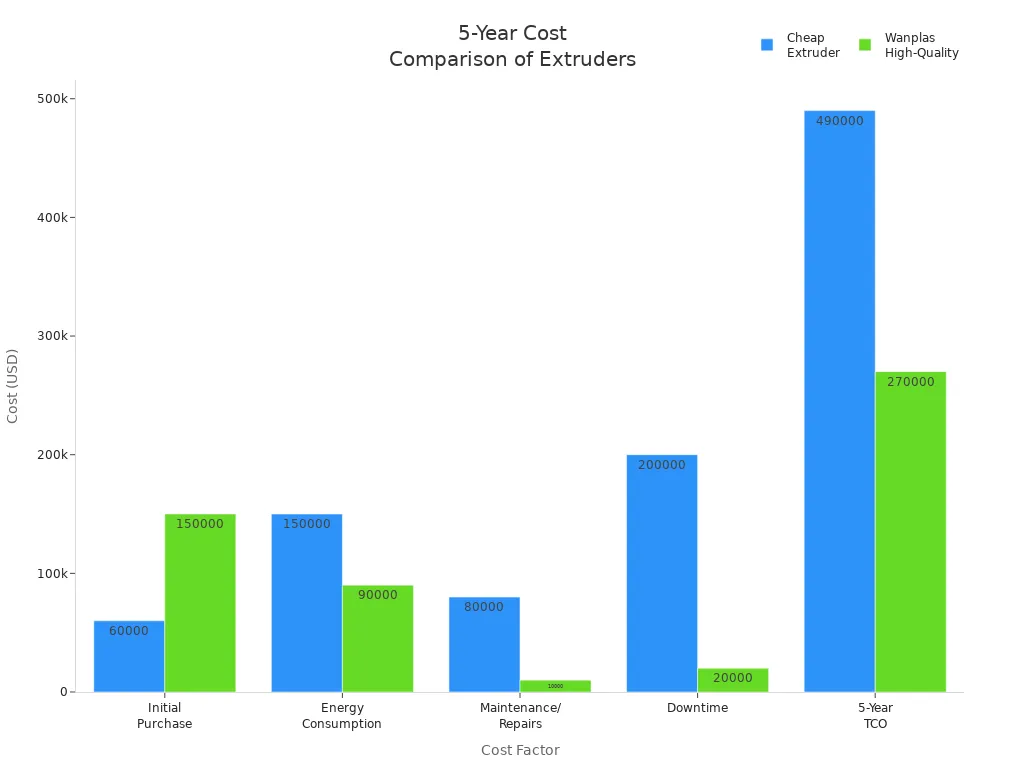
I use this chart to visualize the impact of each cost factor. Energy consumption and downtime stand out as major contributors to long-term expenses. A high-quality extruder minimizes these costs, allowing me to maintain consistent production and reduce unexpected repairs. I have seen that reliable machines keep manufacturing lines running smoothly, which supports higher output and better product quality.
Vihje: I always evaluate the total cost of ownership, not just the initial price. Investing in advanced technology pays off through lower operating costs and fewer disruptions. Monditech’s extruders offer robust performance and efficiency, which helps me achieve long-term savings and maximize return on investment.
I encourage manufacturers to consider all cost factors when selecting an extruder. A careful analysis ensures that the chosen machine supports both immediate needs and future growth. I trust Monditech’s solutions to deliver value across every stage of the manufacturing process.
Choosing the Right Plastic Extruder
Põhiküsimused
When I help manufacturers select the right plastic extruder, I always start by asking targeted questions. These questions clarify production needs and highlight the strengths of each machine type. I use the following table to compare the main considerations for single-screw and twin-screw extruders:
| Funktsioon | Kahe kruviga ekstruuder | Ühe kruviga ekstruuder |
|---|---|---|
| Segamisvõimalused | Provides both spreading and breaking-up mixing | Piiratud segamine, mainly pushes material forward |
| Maksumus | Generally more expensive, suitable for diverse needs | Cheaper, ideal for small companies starting out |
| Production Flexibility | Scales up without losing quality, suitable for varied industries | Fine for low volume production with simple powders |
| Consistency in Output | Fewer bad batches due to consistent mixing | May have more variability in output |
| Hooldus | Self-cleaning, less downtime | More parts to adjust, potentially more downtime |
küsin endalt alati: What materials will I process? How much flexibility do I need for future growth? What level of mixing and consistency does my product require? These questions guide my decision and help me match the extruder to my production goals.
Valiku kontrollnimekiri
I rely on a practical checklist to ensure I cover every critical factor before making a final choice. Here’s the process I follow:
- Define the main product types and target output volume.
- List all materials and additives I plan to process.
- Assess the required mixing quality and consistency.
- Estimate available floor space and facility requirements.
- Calculate the total budget, including installation and training.
- Evaluate energy efficiency and long-term operating costs.
- Review maintenance needs and technical support options.
- Consult with Monditech’s engineering team for tailored recommendations.
Vihje: I always involve my production and maintenance teams early in the selection process. Their input helps me avoid surprises and ensures a smooth transition to new equipment.
Levinud vead
I have seen several common mistakes during plastic extruder selection. To avoid these pitfalls, I always take a comprehensive approach:
- Alamääratlemine – liiga väikese masina valimine ja täisvõimsusel töötamine, mis põhjustab kiiret kulumist ja kvaliteediprobleeme.
- Kogu liini eiramine – keskendudes ainult ekstruuderile ja vaade allavoolu seadmetele, mis võib tekitada kitsaskohti.
- Hoolsuskohustuse vahelejätmine – otsuste tegemine ainult spetsifikatsioonide või tehasekülastuste põhjal, ilma praeguste kasutajatega konsulteerimata.
- Energiakulude tähelepanuta jätmine – madalama hinnaga masina valimine, kuid iga-aastased elektrikulud on suuremad.
Usaldan Monditechi konsultatsiooniteenuseid, mis aitavad mul nende väljakutsetega toime tulla. Nende meeskond annab asjatundlikke juhiseid, tagades, et valin oma vajadustele vastava masina ja väldin kulukaid vigu.
Märkus: Hoolikas planeerimine ja asjatundlik tugi muudavad uude ekstrusioonitehnoloogiasse investeerimise kõik oluliseks.
Ma näen selgeid erinevusi ühe kruviga ekstruuderi ja kahe kruviga plastekstruuderi vahel. Keskendun kvaliteedile, väljund, ja jõudlust, kui valin varustust. Pean alati silmas toodete kvaliteeti ja taaskasutamise eesmärke. Loodan Monditechile usaldusväärse tehnoloogia osas, mis toetab plasti ringlussevõttu ja tagab ühtlase väljundi. Soovitan oma taaskasutusvajadused üle vaadata, eeldatav väljund, ja kvaliteedistandardid. Usaldan Monditechi, et aidata teil saavutada parimat toote kvaliteeti ja jõudlust.
Lisateabe saamiseks, Soovitan võtta ühendust Monditechi ekspertidega või uurida nende ressursse ringlussevõtu ja kvaliteedi parandamise kohta.
KKK
Mis on peamine erinevus ühe kruviga ja kahe kruviga ekstruuderite vahel?
Peamist erinevust näen kruvide arvus ja nende segamisvõimes. Ühe kruviga ekstruuderid saavad hakkama põhiülesannetega. Twin-screw extruders provide advanced mixing and flexibility for complex materials.
When should I choose a twin-screw extruder?
I choose a twin-screw extruder when I need precise mixing, kõrge väljund, or must process complex formulations. This machine works best for compounding, ringlussevõtt, ja erirakendused.
Can I process recycled plastics with Monditech extruders?
Jah, I process recycled plastics efficiently with Monditech’s extruders. Both single-screw and twin-screw models support recycling, but I prefer twin-screw for better mixing and consistent quality.
How do I maintain a plastic extruder for best performance?
I follow a regular maintenance schedule. I clean the screw and barrel, check temperature controls, and inspect moving parts. I trust Monditech’s automated diagnostics to alert me to potential issues early.
What materials can I run on a single-screw extruder?
I run standard thermoplastics, elastomeerid, and regrind materials on a single-screw extruder. This machine handles most basic polymers used in automotive, ehitus, ja pakendamine.
Does Monditech offer technical support and training?
Jah, I rely on Monditech’s expert team for technical support and operator training. They provide installation guidance, tõrkeotsing, and ongoing consultation to keep my production running smoothly.
How do I decide which extruder is right for my operation?
I review my product requirements, materjali tüübid, and production volume. I consult with Monditech’s engineers to match the right extruder to my needs. Their advice helps me avoid costly mistakes.
What certifications do Monditech extruders have?
I confirm that Monditech extruders meet ISO 9001 and other relevant safety standards. These certifications assure me of quality, usaldusväärsus, and compliance with industry regulations.