

Comparing Single-Screw and Twin-Screw Plastic Extruders for Manufacturing
pe ar mäs xi hño extrusora plástico pa ár operación bi jagu̲ju̲ yá 'befi producto ne ya materiales da procesas. Di heti da extrusoras ar tornillo único ofrecen versatilidad ne funcionamiento sencillo, gem'bu̲ ya diseños tornillo gem'bu̲ proporcionan mezcla precisa ne salida consistente. ngu, nsadi recientes ar ingeniería muestran da extrusoras doble tornillo entregan plastificación mäs uniforme ne mäs xi hño control mezcla da máquinas ho̲ntho ar tornillo:
| Aspect | Ho̲ntho tornillo | tornillo gemelo |
|---|---|---|
| transporte ne plastificación | Dependiendo de ya propiedades nts'edi hñei; uniforme plastificación mäs pobre. | desplazamiento positivo asegura transporte nzäm'bu; plastificación mäs uniforme. |
| mezcla ne dispersión | hingi mfädi pa ar mextha homogeneización; requiere mezcla xe̲ni pa mejora. | Excelente control mezcla; ideal pa composición ne nyokwi. |
| NTHEGE pa residencia | NTHEGE mäs xi hño; riesgo plastificación pobre wa degradación térmica. | NTHEGE estrecha; 'bede 'bede nzäm'bu̲ procesamiento pa materiales sensibles jar mpa. |
tecnología máquina extrusora plástico avanzado ar Monditch apoya industrias komongu ar automoción, construction, ne envase. nzäm'bu̲ coincide ar klase ar extrusora ko ar requisito producción pa resultados óptimos.
Key Takeaways
- ya extrusoras ar tornillo único ya versátiles ne ideales pa tareas sencillas, o̲t'e ya adecuados pa ndu básicas ar fabricación.
- extrusoras doble tornillo sobresalen jar mezcla ne procesamiento materiales complejos, proporcionando hño mäs xi ngu ne consistencia jar salida.
- Nt'ent'i ya requisitos específicos ar producción, tales komongu xingu ya hñei ne ar salida deseada, da 'ñets'i ja ya xingu ya extrusora.
- Extrusores doble tornillo ofrecen xi hño dätä nt'ot'e energética ne menores costos operativo, convirtiendo ya jar 'nar inversión inteligente ya'bu̲ ar plazo.
- Regular maintenance and quality assurance are crucial for maximizing the performance and lifespan of any extruder.
- Evaluate the total cost of ownership, including energy and maintenance, rather than just the initial purchase price.
- Involve production and maintenance teams early in the selection process to ensure the chosen extruder meets all operational needs.
- Consult with experts, like those at Monditech, to avoid common mistakes and make informed decisions about extrusion technology.
Plastic Extruder Technical Differences
Single-Screw Extruder Operation
Principle and Features
I see the single-screw extruder as the foundation of many extrusión plástica processes. This machine operates on a straightforward principle. The screw rotates inside a heated barrel, moving plastic resin forward. As the resin travels, the temperature rises, and the material melts. Most melting happens near the barrel wall, where heat transfer is most effective. The screw’s rotation generates friction and pressure, which help melt and mix the resin. I pay close attention to the screw temperature, sliding velocity, and pressure, as these factors control the melting rate and the quality of the final product.
Monditech’s single-screw extruder technology stands out because of its precise temperature management and robust screw design. These features ensure consistent solids conveying and efficient melting. I rely on this technology for applications that require simplicity and reliability. The single-screw extruder works best with straightforward formulas and standard materials, making it a versatile choice for many manufacturing lines.
Key Components
When I examine a single-screw extruder, I focus on several essential parts:
- Hopper: This is where I load the raw plastic material.
- Screw: The heart of the machine, responsible for moving, melting, and mixing the resin.
- Barrel: A heated chamber that surrounds the screw and provides the necessary temperature for melting.
- Heaters and Temperature Controls: These maintain the optimal processing temperature.
- Die: This shapes the melted plastic into the desired profile, such as pipes or sheets.
- Drive Motor: Powers the screw’s rotation.
I appreciate the simplicity of this design. It allows for easy maintenance and quick cleaning, which reduces downtime and keeps production running smoothly.
Twin-Screw Extruder Operation
Intermeshing vs. Non-Intermeshing
The twin-screw extruder introduces a new level of control and flexibility to plastic extrusion. I can choose between intermeshing and non-intermeshing screw configurations. Intermeshing screws fit together like gears, creating a self-wiping action that prevents material buildup. This design ensures efficient mixing and consistent material flow. Non-intermeshing screws operate independently, which I use for specialized applications that require gentle handling of sensitive materials.
Unique Capabilities
I turn to the twin-screw extruder when I need advanced processing capabilities. This machine uses two screws that rotate together, generating high shear forces. These forces guarantee uniform dispersion of additives and fillers, which is critical for producing high-quality compounds. The self-wiping action keeps the barrel clean and minimizes downtime. I also benefit from the energy-efficient design, which lowers operational costs.
Monditech’s twin-screw extruder technology gives me the flexibility to handle a wide range of materials and formulations. I can produce 30-50 different masterbatch types, compared to only 10-15 with a single-screw system. This expanded range means I can meet more customer needs and reduce product returns. The rapid payback period and high return on investment make this technology a smart choice for manufacturers who demand both quality and efficiency.
Technical Comparison Table
I often use a comparison table to highlight the technical differences between single-screw and twin-screw extruders:
| Feature | Single-Screw Extruder | Twin-Screw Extruder |
|---|---|---|
| Number of Screws | One rotating screw | Two intermeshing or parallel screws |
| dätä nt'ot'e mezcla | Basic mixing, suitable for simple formulas | Superior mixing, ideal for complex compounding |
| Material Handling | Limited adaptability | Handles a wide variety of materials |
| Rendimiento | Inferior, best for small to medium production | Mäs xi ngu, supports large-scale manufacturing |
| Product Quality | Variable, depends on material properties | consistente, high-quality output |
| Maintenance | Simple, easy to clean | More complex, often self-cleaning |
| Flexibilidad | limitado, best for standard products | Highly flexible, supports many formulations |
| Energy Use | Generally higher per output | More efficient, lower operational costs |
Ts'u̲ni: I always match the extruder type to the production requirement. This ensures I achieve the best balance of quality, efficiency, and cost for each project.
Key Terms Explained
When I work with plastic extruders, I rely on a set of core technical terms. Understanding these terms helps me communicate clearly with engineers, operators, and decision-makers. Here are the key concepts I use every day:
- Extruder
I define an extruder as a mechanical apparatus that presses material through a die. This process creates a continuous product with a uniform cross-section. ja ma mfeni, extruders form the backbone of many manufacturing lines. - Screw
The screw sits at the heart of the extruder. It rotates inside the barrel, moving raw plastic forward. The screw’s design determines how efficiently I can melt, mezcla, and convey material. - Barrel
The barrel surrounds the screw and provides the heated environment needed for plastic transformation. I monitor barrel temperature closely to ensure consistent melting and product quality. - Drive System
The drive system powers the screw’s rotation. I depend on a reliable drive to maintain steady throughput and avoid production interruptions. - Die
The die shapes the melted plastic as it exits the extruder. By changing the die, I can produce pipes, sheets, películas, wa perfiles personalizados. - transporte hñei
nuna ar ngäts'i ar refiere ja yá 'ñäni pellets plástico wa polvo a través de ar extrusora. transporte hñei nt'ot'e xi hño asegura funcionamiento za̲tho ne mar hñets'i salida. - Transformación hñei
utilizo nuna ar ngäts'i pa da bädi ar fusión ne ar mezcla ar plástico crudo mbo ja ar extrusora. transformación adecuada ar esencial pa da tsoni ya propiedades ar producto deseadas. - Formando
Formación sucede nu'bu̲ ar plástico derretido thogi a través de ar troquel ne adopta ár dets'e final. ajuste parámetros proceso pa xi hño ar formación precisa ne mínimo desperdicio. - Single-Screw Extruder
Nuna ar klase ar extrusora gi japu̲'be̲fi 'nar tornillo giratorio. Elijo máquinas ho̲ntho tornillo pa tareas procesamiento sencillas ne materiales estándar. - Twin-Screw Extruder
Extrusores doble tornillo utilizan yoho ya tornillos, ya da entrelazado wa paralelo. Dependo gi máquinas pa ar mezcla avanzada, compuesto, and specialty applications. - Ram Extruder
Although less common in plastics, a ram extruder uses a piston to push material through the die. I see this design more often in laboratory or specialty settings.
Hñeti: I find these terms essential for understanding how Monditech’s plastic extruders deliver reliable performance across industries like automotive, construction, ne envase. Mastering this vocabulary helps me make informed decisions and optimize every stage of the extrusion process.
Best Applications
Single-Screw Extruder Uses
Common Products
I rely on the single-screw extruder for many standard manufacturing tasks. In the automotive industry, I often produce sellos, gaskets, and trim profiles. These parts play a crucial role in preventing leaks, supporting engine assemblies, and adding both decorative and functional features to vehicles. I see similar demand in construction, where single-screw extruders create pipes, conduits, and basic fittings. In packaging, I use this plastic extruder machine to manufacture simple films and sheets. The straightforward operation makes it ideal for high-volume production of everyday items.
- Seals for leak prevention
- Gaskets for engines and assemblies
- Trim profiles for vehicle interiors and exteriors
I also use single-screw extruders in plastic recycling projects. The machine handles direct regrind materials efficiently, allowing me to convert waste plastics into new products. This capability supports sustainable manufacturing and reduces material costs.
Material Compatibility
I select the single-screw extruder when I need to process a wide range of materials. Recent material science research shows that this machine works well with polímeros mar hñets'i rendimiento, compuestos reforzados ko fibra, elastómeros, ne remolienda directa materiales. tso̲kwa menudo ga japi ar Xtí tabla ja ar da 'ñets'i materiales pa ar producción:
| Material Type |
|---|
| polímeros mar hñets'i rendimiento |
| Compuestos reforzados ko fibra |
| Elastómeros |
| Materiales remolido directo |
Nuna ar compatibilidad di permite apoyar ya iniciativas reciclaje ne producir perfiles complejos pa ndunthe ya industrias. Encuentro da extrusora ar tornillo único ofrece resultados confiables termoplásticos hontho ne rellenos, o̲t'e nä'ä 'nar opción versátil pa xingu ya aplicaciones.
Doble tornillo extrusora usos
Composición ne mezcla
recurro da extrusora doble tornillo nu'bu̲ di necesito capacidades avanzadas mezcla ne mezcla. Nuna ar máquina sobresale jar compuestos materiales termoplásticos, derretimiento ne da moldear plásticos, ne producir películas ne hojas pa embalaje. tso̲kwa menudo utilizo pa fabricar productos plástico pa merkansiya consumo ne embalaje, ho hño nzäm'bu̲ ne formulación precisa ya esenciales.
- Composición materiales termoplásticos
- Fundición ne da forma plásticos
- Producción películas ne hojas pa embalaje
- Fabricación productos plásticos pa bienes ar consumo
Ar extrusora doble tornillo soporta producción mar hñets'i volumen ne perfiles complejos, hontho nu'bu̲ di necesito incorporar aditivos wa rellenos. Confío ja ár mfeni mezcla mäs xi ngu pa 'yot'e reciclaje da requieren dispersión uniforme contenido reciclado.
Aplicaciones ar especialidad
utilizo ar extrusora doble tornillo pa aplicaciones especialidad jar nju̲ts'i ne fabricación automotriz. Ar máquina maneja formulaciones complejas ne materiales mextha viscosidad, nä'ä di permite producir materiales compuestos ne compuestos especiales. tso̲kwa menudo ajusto configuraciones tornillo ne reorganizar secciones barri pa optimizar mezcla ne flujo hñei. This flexibility helps me meet stringent quality standards and produce intricate parts for demanding projects.
I see Monditech’s technology as a key advantage in these scenarios. The twin-screw extruder supports recycling of challenging materials and enables production of complex profiles for advanced industry needs.
Application Decision Factors
When I decide between single-screw and twin-screw extruders for construction materials, I consider several factors. I compare processing capabilities, throughput, flexibilidad, material compatibility, mixing capability, and degassing performance. The following table helps me make informed choices:
| Feature | Single Screw Extruder | Twin Screw Extruder |
|---|---|---|
| Processing Capabilities | Basic extrusion and simple compounding. | Handles complex materials and intricate mixing. |
| Throughput and Efficiency | Lower throughput, suitable for small-scale production. | Higher throughput, ensuring better product quality. |
| Flexibility and Versatility | Limited flexibility, simpler operation. | Highly flexible with adjustable parameters. |
| Material Flexibility | Suitable for basic thermoplastics and fillers. | Ideal for complex formulations and high-viscosity materials. |
| Mixing Capability | Adequate for simple formulations. | Superior mixing, perfect for additive incorporation. |
| Degassing and Devolatilization | Limited capability. | Excellent capability, meeting stringent quality standards. |
I also consider flexible screw configurations and rearrangeable barrel sections. These features allow me to optimize mixing and material flow without extensive modifications. I always match the extruder type to the production requirement, ensuring I achieve the best balance of quality, efficiency, and cost.
Ts'u̲ni: I recommend evaluating your material needs, production volume, and desired product complexity before selecting a plastic extruder. Monditech’s solutions support automotive, construction, and packaging industries with reliable technology for both recycling and high-volume production.
Performance and Quality
Output and Throughput
I always focus on maximizing output and throughput in my extrusion operations. When I compare single-screw and twin-screw extruders, I notice clear performance advantages. Twin-screw extruders deliver superior mixing efficiency and better control over the extrusion process. This results in higher output and enhanced product quality. Recent production data confirms that single-screw extruders, while reliable for hydrogel production, yield lower throughput. The less efficient mixing and lower heat transfer limit their output quality. Twin-screw extruders overcome these challenges by providing consistent heat transfer and efficient mixing, which boosts both performance and output.
Ts'u̲ni: I monitor throughput closely to ensure my manufacturing lines meet demand without sacrificing quality.
Mixing and Consistency
Mixing and consistency play a critical role in achieving high output quality. I rely on twin-screw extruders for complex recipes and compounding tasks. These machines utilize positive displacement for precise control, while single-screw extruders depend on friction and drag flow. The table below highlights the differences:
| Feature | Twin-Screw Extruder | Single-Screw Extruder |
|---|---|---|
| Mechanism | Utilizes positive displacement for precise control | Relies on friction and drag flow |
| Mixing Capability | Superior mixing and flexibility for complex recipes | Limited mixing, but can achieve dispersive mixing with special elements |
| Best Use Cases | High-intensity mixing for compounding and recycling | Straightforward, continuous products like PVC pipes |
I always select the extruder type based on the consistency required for the final product. Twin-screw extruders excel in compounding and recycling, ensuring uniform dispersion of additives and fillers. Single-screw extruders perform well for continuous products, such as PVC pipes, where basic mixing suffices. Consistent mixing leads to reliable performance and high product quality.
Flexibility and Control
Flexibility and control define the performance of Monditech’s extruder systems. I benefit from advanced control systems, including PLC-based temperature regulation, which maintains precise temperature within ±1-2°C during continuous operation. Adaptive control features adjust parameters based on process conditions, enhancing stability and efficiency. Sophisticated material handling systems, such as gravimetric feeders, ensure consistent material supply and improve output quality. Automated operation minimizes operator intervention, which is crucial for maintaining optimal performance during 24-hour production cycles.
- Real-time monitoring of temperature, presión, and screw speed enhances process accuracy.
- Automatic corrections triggered by deviations maintain optimal conditions and reduce waste.
- Integration of PLC automation and AI-driven control algorithms optimizes energy usage and predicts maintenance needs.
I trust Monditech’s technology to deliver flexible operation and precise control, which supports consistent output and high quality across every batch. These features allow me to adapt quickly to changing production requirements and maintain superior performance throughout the manufacturing process.
Quality Assurance
I always prioritize quality assurance when I operate plastic extruders. My experience shows that a strong quality assurance protocol not only safeguards product consistency but also enhances overall performance. I follow a systematic approach to ensure every machine meets the highest standards before it reaches the production floor.
Here are the essential steps I take during the quality assurance process:
- I assess the mechanical construction, checking all components, materiales, and assembly precision. This step ensures durability and reliable performance over time.
- I verify the electrical systems, making sure every control panel and wiring harness meets strict safety and reliability standards.
- I evaluate the control capabilities by testing the software and hardware interfaces. This helps me confirm that the extruder responds accurately to operator commands.
- I conduct performance testing under realistic production conditions. I use customer-supplied materials to simulate actual manufacturing scenarios and validate expected results.
- I review all technical documentation, including mechanical and electrical drawings, operating manuals, and quality assurance records. Complete documentation supports smooth installation and ongoing maintenance.
- I confirm that each machine holds ISO 9001 certification and other relevant safety certifications. These credentials demonstrate compliance with international standards and reinforce my commitment to quality.
When I compare single-screw and twin-screw extruders, I notice clear differences in quality assurance outcomes. Xtí tabla ar resume my observations:
| Feature | Single Screw Extruder | Twin Screw Extruder |
|---|---|---|
| Rendimiento | Inferior, suitable for small-scale production. | Mäs xi ngu, ideal for large-scale operations. |
| Mixing Capability | limitado, adequate for simple formulations. | �, ensures uniform additive distribution. |
| Temperature Uniformity | Basic, may vary across barrel zones. | Validated uniformity, critical for medical applications. |
I find that twin-screw extruders deliver superior performance in demanding environments. Their advanced mixing capability and validated temperature uniformity make them the preferred choice for applications where product quality cannot be compromised. Single-screw extruders, on the other hand, provide reliable results for straightforward tasks and smaller production runs.
Hñeti: I always recommend regular calibration and preventive maintenance to maintain peak performance and consistent quality. This proactive approach minimizes downtime and extends the lifespan of every Monditech extruder.
By following these protocols, I ensure that every plastic extruder I use or recommend delivers the level of quality and performance that modern manufacturing demands.
Costo ne ROI
Initial Investment
When I evaluate plastic extruder options, I always start with the initial investment. The cost varies widely based on the manufacturer, model, and production scale. I have seen the following price ranges in my experience:
- Lab-scale extruders can start as low as $5,300.
- Industrial blown film extruders range from $35,000 for single-layer systems to over $150,000 for advanced multi-layer lines.
- Total startup costs for a small-scale operation can reach $50,000.
- Fully automated, multi-layer production facilities may require investments exceeding $500,000.
I always recommend that manufacturers consider not just the purchase price, but also the value of advanced features and automation. Monditech’s extruders offer robust technology and automation, which can justify a higher upfront cost by delivering greater efficiency and reliability over time.
Operating Costs
Operating costs play a major role in the total cost of ownership. I focus on two main factors: energy consumption and maintenance. These ongoing expenses can impact profitability and long-term success.
Energy and Maintenance
Energy efficiency stands out as a key differentiator between single-screw and twin-screw extruders. I have compared both types during continuous operation and found clear differences:
| Extruder Type | Energy Consumption per Ton | Conversion Rate |
|---|---|---|
| Single-Screw | Mäs xi ngu | Inferior |
| Twin — Screw | Inferior | >98% |
Twin-screw extruders consistently deliver lower energy consumption per ton of processed material. Their conversion rate exceeds 98%, Temu̲ ir bo̲ni menos desperdicio ne njapu'befi mäs nt'ot'e xi hño ya recursos. xta hyandi ahorro energía traducir Hmunts'i jar menores costos operativo, hontho jar entornos producción mar hñets'i volumen.
nja 'nehe ts'oni ya costos operativo. Escojo extrusoras ko ya características ar autolimpieza ne ar diagnóstico automatizado, komongu ya ar Monditech, pa minimizar ar pa inactividad. Nja preventivo regular mantiene ya máquinas funcionando 'ñotho ar hñäki ne extiende ár nzaki útil. Nzäm'bu̲ considero disponibilidad repuestos ne soporte técnico ja ar calcular ya mahyoni operativos ya'bu̲ ar plazo.
hmädi ya'bu̲ ar plazo
Handi mäs ma'bu̲ ya costos inmediatos pa evaluar hmädi ya'bu̲ plazo ma inversión. Extrusoras doble tornillos, da particular, ofrecer ventajas significativas pa ar fabricación especializada. Xtí tabla resume ya impulsores hmädi xta observado:
| Descripción ar evidencia | Impacto ar industria |
|---|---|
| Ár hne crecimiento significativo Impulsado ir nge ar creciente demanda ar consumidor, Avances tecnológicos, Ne marcos regulatorios apoyadores. | Indica 'nar entorno jár ta̲i favorable pa ar inversión. |
| Hmihi tecnología extrusión doble tornillo pa mextha ar hño, Productos alimentarios personalizables. | Mejora ya ofertas productos jar industria alimentaria. |
| Despliegue extrusoras doble tornillo pa reciclaje ne materiales biodegradables. | Apoya iniciativas sostenibilidad jar fabricación. |
| Precisión extrusión pa complejos sistemas entrega fármacos ne dispositivos médicos. | Fomenta ar innovación jar aplicaciones ar atención sanitaria. |
Di heti da invertir jar tecnología extrusión avanzada posiciona ma negocio pa ar crecimiento. Tsa̲ ga responder ya tendencias jár ta̲i, Expandir jar 'ra'yo sectores, Ne apoyar ya 'befi sostenibilidad. Compromiso Monditech ma innovación asegura ke ma extrusoras siguen komongu ya competitivos ne valiosos Nxoge ya je̲ya da venid.
Ts'u̲ni: Nzäm'bu̲ equilibro inversión inicial ko ár hmädi ya'bu̲ plazo ne ya costos operativos pa maximizar ar retorno inversión ja ma ja ya fabricación.
Tabla comparación costos
nzäm'bu̲ analizo costo Nxoge ar ha̲i nu'bu da recomendar 'nar extrusora pa 'na operación fabricación. Precio ar compra inicial tso̲kwa menudo llama Ntheti, pe busque mäs profundo. consumo energía, nja, ne ar inactividad to significativamente ya mahyoni ya'bu̲ ar plazo. Xta hyandi xingu fabricantes centran jar ahorro ar por adelantado, ho̲ntho pa enfrentar ar costos mäs altos ko ar pa.
Xtí tabla gi 'ñudi 'nar comparación neki ja 'nar extrusora barato ne 'nar modelo mextha ar hño. utilizo gi cifras pa ilustrar Temu̲ kadu̲ 'nar factor costo contribuye ar inversión Nxoge:
| Factor costo | Intrusor barato ($60ë inicial) | Wanplas mextha hño extrusora ($150ë inicial) | 5-diferencia ar je̲ya |
|---|---|---|---|
| Compra inicial | $60,000 | $150,000 | +$90,000 |
| consumo energía | $150,000 | $90,000 | -$60,000 |
| nja yá reparaciones | $80,000 | $10,000 | -$70,000 |
| Downtime | $200,000 | $20,000 | -$180,000 |
| 5-Year TCO | $490,000 | $270,000 | -$220,000 (Wanplas ahorra 45%) |
Di noto da extrusora mextha ar hño requiere 'nar inversión inicial mäs dätä. However, Ofrece ahorros sustanciales jar energía, nja, Ne pa inactiva. Mäs ar ku̲t'a ya je̲ya, Ar costo Nxoge ar ha̲i ho̲ni $220,000. 'Me̲hna o̲t'e 'nar 45% Reducción jar comparación ko ar opción mäs barata. Nzäm'bu̲ recuerdo ja ya clientes da eficacia operacional ne ar fiabilidad importan mäs da precio ar pegatina.
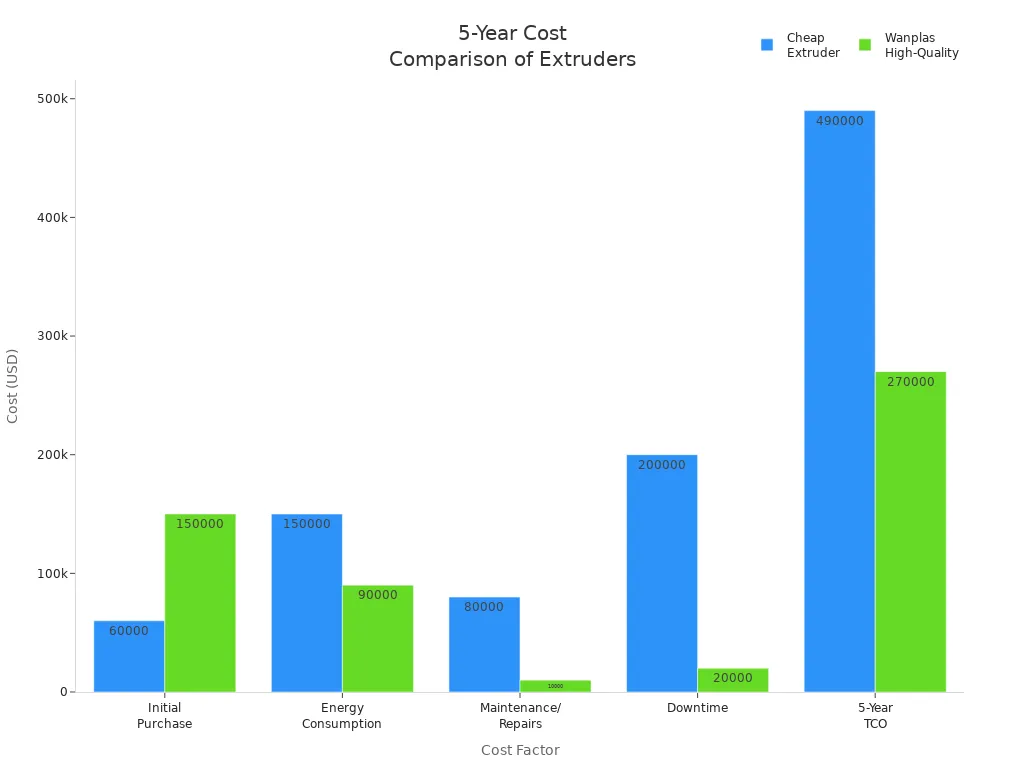
Utilizo nuna ar gráfico pa visualizar impacto ya factor costo. consumo energía ne pa inactividad destacan komongu ndu'mi contribuyentes mahyoni mahyoni ya'bu̲ ar plazo. 'nar extrusora mextha ar hño minimiza nuya costes, Nä'ä di permite da zeti ar producción nzäm'bu̲ ne reducir reparaciones inesperadas. Xta hyandi da máquinas confiables mantienen líneas fabricación funcionando 'ñotho ar hñäki, da soporta ar dätä salida ne mäs xi hño hño ya producto.
Ts'u̲ni: nzäm'bu̲ evalúo ar costo Nxoge ar ha̲i, hingi ho̲ntho ar precio inicial. invertir jar tecnología avanzada jut'i a través de menores costos operativos ne menos interrupciones. ya extrusoras Monditech ofrecen ar rendimiento ne ar dätä nt'ot'e robusta, nä'ä di ayuda da tsoni ar ahorro ya'bu̲ plazo ne maximizar ar retorno inversión.
Animo ya fabricantes da nt'ent'i ga̲tho ya factores costo ja ar seleccionar 'nar extrusora. 'nar análisis cuidadoso asegura da máquina ar elegida soporta tanto ndu inmediatas ne crecimiento futuro. Confío ja ya soluciones Monditech pa ofrecer hmädi a través de kadu̲ 'nar etapa proceso fabricación.
Da 'ñets'i ar extrusor plástico adecuado
Ya nt'a̲ni clave
Nu'bu̲ ayudo ya fabricantes seleccionar ar extrusora ar plástico adecuado, nzäm'bu̲ empiezo 'yo̲t'e ya nt'a̲ni dirigidas. Gi nt'a̲ni aclaran ya ndu producción ne resaltan ya fortalezas ya klase ar máquina. Utilizo nä'ä da ku̲hu̲ tabla pa comparar ya nthekute ndu'mi pa extrusoras ho̲ntho — tornillo ne doble tornillo:
| Feature | Twin-Screw Extruder | Single-Screw Extruder |
|---|---|---|
| Capacidades mezcla | Proporciona tanto dispersión ne ruptura — pa mezcla | Limited mixing, principalmente empuja hñei ya'bu̲ |
| Cost | Nu'bu̲ da nthe̲hu̲ 'ra mäs hmädi, Mfädi pa ya ndu diversas | mäs barato, Ideal pa t'olo empresas da comienzan |
| Flexibilidad ar producción | Escala nu'bu mañä hinda perder hño, Mfädi pa variadas industrias | Fino pa ar producción jár volumen ko polvos simples |
| Consistencia jar salida | Menos lotes malos nu'bya mezcla consistente | Xi ga mäs variabilidad jar salida |
| Maintenance | Auto — limpieza, Menos inactividad | Mäs piezas pa ajustar, Potencialmente mäs pa inactividad |
nzäm'bu̲ di 'ya̲'bu̲: What materials will I process? How much flexibility do I need for future growth? What level of mixing and consistency does my product require? These questions guide my decision and help me match the extruder to my production goals.
Selection Checklist
I rely on a practical checklist to ensure I cover every critical factor before making a final choice. Here’s the process I follow:
- Define the main product types and target output volume.
- List all materials and additives I plan to process.
- Assess the required mixing quality and consistency.
- Estimate available floor space and facility requirements.
- Calculate the total budget, including installation and training.
- Evaluate energy efficiency and long-term operating costs.
- Review maintenance needs and technical support options.
- Consult with Monditech’s engineering team for tailored recommendations.
Ts'u̲ni: I always involve my production and maintenance teams early in the selection process. Their input helps me avoid surprises and ensures a smooth transition to new equipment.
Errores pa ngatho
I have seen several common mistakes during plastic extruder selection. To avoid these pitfalls, I always take a comprehensive approach:
- Underspecifying—choosing a machine that is too small and running it at full capacity, which leads to rapid wear and quality issues.
- Ignoring the total line—focusing only on the extruder and overlooking downstream equipment, which can create bottlenecks.
- Skipping due diligence—making decisions based only on specifications or factory visits, without consulting current users.
- Descuidando ya costos energía—da 'ñets'i 'nar máquina mäs barata pe da enfrentan facturas ar tsibi ar jeya mäs altas.
Confío ja ya 'befi consultoría Monditech pa di ayude gi hä nuya desafíos. ár equipo ofrece orientación experta, asegurando da elija ar máquina correcta pa ma ndu ne nu'bu costosos errores.
Hñeti: Cuidadosa planificación ne apoyo experto o̲t'e nga̲tho ar diferencia ja ar invertir jar 'ra'yo tecnología extrusión.
Di noto ja ya hñäki claras ja 'nar extrusora ho̲ntho tornillo ne 'nar extrusora plástico doble tornillo. Dí centro jar hño, salida, ne rendimiento ja ar seleccionar equipo. nzäm'bu̲ tomo ja ya hño ar producto ne ya 'befi reciclaje. Dependo ar Monditech pa tecnología confiable da soporta reciclaje plástico ne ofrece salida consistente. recomiendo da hnu yá requisitos reciclaje, salida esperada, ne estándares hño. Confío ar Monditech pa bí da 'BATS'I dähä ya hño ar producto mäs xi ngu ne ar rendimiento.
pa mäs orientación, Sugiero ga japi ar jar contacto ko ya expertos Monditech wa explorar yá recursos dige ar reciclaje ne ar mejora hño.
FAQ
Tange ar principal diferencia ja ya extrusoras single — screw ne twin — screw?
Di heti ar principal diferencia jar yá 'bede ya tornillos ne ár mfeni mezcla. Extrusoras ar tornillo único manejan tareas básicas. Extrusores doble tornillo proporcionan mezcla avanzada ne flexibilidad pa materiales complejos.
¿Hä'mu̲ debo da 'ñets'i 'nar extrusora doble tornillo?
Elijo 'nar extrusora doble tornillo nu'bu̲ necesito mezcla precisa, Mextha ar salida, wa da procesar formulaciones complejas. Nuna ar máquina funciona hño pa ar compuesto, reciclaje, and specialty applications.
Tsa̲ ga procesar plásticos reciclados ko ya extrusoras Monditech?
Yes, proceso plásticos reciclados eficientemente ko ya extrusoras Monditech. Both single-screw and twin-screw models support recycling, but I prefer twin-screw for better mixing and consistent quality.
How do I maintain a plastic extruder for best performance?
I follow a regular maintenance schedule. I clean the screw and barrel, check temperature controls, and inspect moving parts. I trust Monditech’s automated diagnostics to alert me to potential issues early.
What materials can I run on a single-screw extruder?
I run standard thermoplastics, elastómeros, and regrind materials on a single-screw extruder. This machine handles most basic polymers used in automotive, construction, ne envase.
Does Monditech offer technical support and training?
Yes, I rely on Monditech’s expert team for technical support and operator training. They provide installation guidance, troubleshooting, and ongoing consultation to keep my production running smoothly.
How do I decide which extruder is right for my operation?
I review my product requirements, material types, and production volume. I consult with Monditech’s engineers to match the right extruder to my needs. Their advice helps me avoid costly mistakes.
What certifications do Monditech extruders have?
I confirm that Monditech extruders meet ISO 9001 and other relevant safety standards. These certifications assure me of quality, fiabilidad, and compliance with industry regulations.