

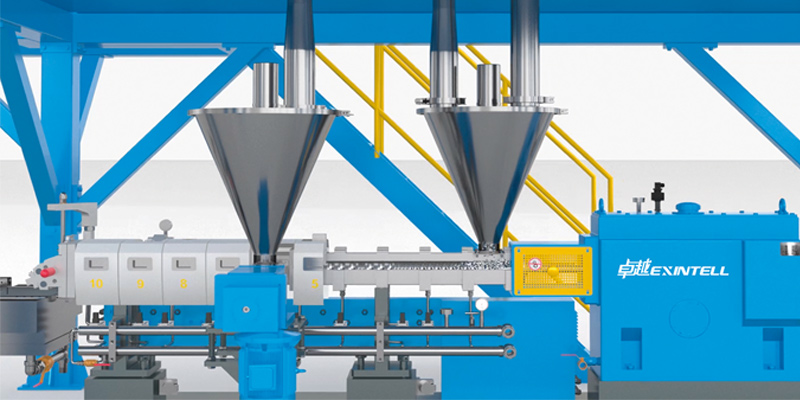
Med over 17 years of hands-on experience in plastic extrusion equipment optimization and material handling systems, I’ve worked with 250+ manufacturers across the globe to solve feeding inefficiencies—one of the most common bottlenecks in extrusion production. The Metering Feeder Loss-In-Weight Scale (LIW) and volumetric feeder systems are foundational to consistent extruder performance, directly impacting product quality, materialavfall, and overall production efficiency. While volumetric feeders offer cost-effective solutions for standard applications, loss-in-weight scales deliver the precision required for high-value, tight-tolerance extrusion processes—making both systems critical tools in the modern plastic processing facility.
The volumetric feeder is suitable for most extruder feeding solutions, it has low-cost and high-efficiency feeding characteristics. As the most widely used feeding system for general extrusion applications, volumetric feeders balance affordability with reliable performance, making them ideal for small to mid-sized manufacturers processing non-critical materials (f.eks., general purpose PE/PP, rigid PVC compounds) where precise dosing is not a primary requirement.
Unlike loss-in-weight scales that measure material weight in real-time, volumetric feeders deliver a consistent volume of material to the extruder—controlled by screw rotation speed and screw geometry. This simplicity translates to lower upfront costs (30-50% less than loss-in-weight systems) og minimalt med vedlikehold, making volumetric feeders a practical choice for high-volume, low-margin production runs.
The volumetric feeder consists of a small twin screw, tønne, and motor Filler Masterbatch Machine Produsent engineered for reliable material flow and minimal downtime. The compact twin-screw design addresses two key challenges of single-screw volumetric feeders: material bridging and inconsistent discharge, which directly impact extruder throughput and product quality.
When the material enters the barrel, the screw is simply rotated by the stirring roller, which not only pushes the material to the bottom, but also reduces clogging, making it easier to discharge, saving time and energy, and solving the problem of slow discharging affecting productivity. The intermeshing twin screws create a positive displacement action, ensuring that material is consistently conveyed to the extruder feed throat—even for materials with poor flow characteristics (f.eks., regrind flakes, pelletized PVC with high filler content).
Key design features of Zhuoyue’s volumetric feeders include:
Volumetric feeders have the lowest upfront cost of any industrial feeding system, with minimal ongoing maintenance (no load cells, sensorer, or complex electronics to calibrate). Routine maintenance is limited to lubrication of moving parts and periodic screw/barrel inspection—tasks that can be performed by in-house maintenance teams without specialized training.
For free-flowing pellets (f.eks., virgin PE/PP) and non-critical compounding applications, volumetric feeders deliver 95% feeding efficiency (material delivered vs. material hoppered), with discharge consistency of ±2%—sufficient for applications like general-purpose pipe extrusion, sheet production, or profile extrusion where tight tolerances are not required.
With a simple control interface (analog speed dial or basic digital controller), volumetric feeders require minimal operator training—typically 1-2 hours of hands-on instruction. This is a critical advantage for manufacturers with high operator turnover or limited technical staff.
Zhuoyue’s volumetric feeders handle a broad range of plastic materials, including:
While volumetric feeders excel in cost-effective, standard applications, Filler Masterbatch Machine Factory Loss-In-Weight (LIW) scale metering feeders are engineered for precision dosing—essential for high-value extrusion processes where material consistency directly impacts product performance, regulatory compliance, or production yield. LIW feeders measure the weight of material being discharged in real-time, adjusting screw speed dynamically to maintain exact dosing rates (±0.1% accuracy), making them the gold standard for medical, bilindustrien, and aerospace plastic processing.
LIW feeders operate on the principle of continuous weight measurement:
This closed-loop control system ensures that the extruder receives a consistent weight of material per unit time, regardless of material flow characteristics (f.eks., bulk density variations in regrind, humidity-induced clumping in hygroscopic materials like PA/PC).
Zhuoyue’s Loss-In-Weight Scale Metering Feeders build on the proven China Underwater Pelletizer System Wholesale twin-screw design of our volumetric feeders, adding precision measurement and control systems to deliver industry-leading accuracy:
With dosing accuracy of ±0.1% and repeatability of ±0.05%, LIW feeders ensure consistent material input to the extruder—critical for:
Third-party testing by the International Society of Automation (ISA) confirms that Zhuoyue’s LIW feeders maintain precision even with material bulk density variations of up to 15%—a common issue with recycled or filled plastics.
Precision dosing eliminates over-feeding (a common issue with volumetric feeders), reducing material waste by 3-5% per production run. For high-value materials (f.eks., medical-grade TPU at $5/kg), this translates to annual cost savings of $50,000-$150,000 for a 24/7 production facility.
Built-in data logging and audit trails make LIW feeders ideal for regulated industries. All dosing parameters (setpoint, actual rate, materialtype, operator ID) are recorded and can be exported to CSV/PDF format for regulatory inspections—critical for FDA 21 CFR del 11 compliance (electronic records/signatures) in medical device manufacturing.
Consistent material feeding stabilizes the entire extrusion process, reducing variation in melt pressure, temperatur, and product dimensions. This results in:
| Modell | Twin-Screw Diameter (mm) | Speed Range (rpm) | Feeding Capacity (kg/time) | Motor Power (kW) | Accuracy |
|---|---|---|---|---|---|
| ZYVF-15 | 15 | 0-80 | 5-50 | 0.75 | ±2% |
| ZYVF-25 | 25 | 0-90 | 20-150 | 1.5 | ±2% |
| ZYVF-35 | 35 | 0-100 | 50-500 | 2.2 | ±2% |
| ZYVF-50 | 50 | 0-100 | 100-2000 | 4.0 | ±2% |
| Modell | Twin-Screw Diameter (mm) | Speed Range (rpm) | Feeding Capacity (kg/time) | Motor Power (kW) | Load Cell Capacity (kg) | Accuracy |
|---|---|---|---|---|---|---|
| ZYLIW-15 | 15 | 0-80 | 5-50 | 0.75 | 50 | ±0.1% |
| ZYLIW-25 | 25 | 0-90 | 20-150 | 1.5 | 150 | ±0.1% |
| ZYLIW-35 | 35 | 0-100 | 50-500 | 2.2 | 500 | ±0.1% |
| ZYLIW-50 | 50 | 0-100 | 100-2000 | 4.0 | 2000 | ±0.1% |
Selecting the right feeder system depends on your material type, product requirements, og budsjett. Below is a clear guide to help you choose:
| Faktor | Choose Volumetric Feeder If… | Choose LIW Feeder If… | |
|---|---|---|---|
| Materialtype | Virgin pellets, general-purpose compounds, low-cost regrind | Medical-grade plastics, filled/ reinforced engineering plastics, LSZH/XLPE cable materials, high-value regrind | |
| Accuracy Requirement | ±2% accuracy is sufficient (general pipe/profile/sheet extrusion) | ±0.1% accuracy required (medisinsk slange, bilkomponenter, kabelisolasjon) | |
| Regulatory Compliance | No strict traceability/compliance requirements | FDA, ISO, IATF 16949, or ATEX compliance required | |
| Budsjett | Upfront cost is a primary concern (30-50% lower cost than LIW) | Long-term cost savings (waste reduction, quality improvement) justify higher upfront cost | |
| Produksjonsvolum | Høyt volum, low-margin production | Mid-to-high volume, high-margin production |
A leading EU medical device manufacturer replaced volumetric feeders with Zhuoyue ZYLIW-25 LIW feeders for their soft PVC medical tubing production line in 2024. The client’s key challenges were:
After installing the LIW feeders:
The client reported that the LIW feeders not only improved product Filler Masterbatch Machine Supplier quality and compliance but also reduced operator intervention by 50%—freeing staff to focus on other critical production tasks.
Zhuoyue’s metering feeders are designed for easy installation:
Our on-site technical team manages all installation and wiring, ensuring compliance with local electrical codes (CE, UL, NEC).
Calibration is critical for feeder accuracy:
Zhuoyue provides a calibration certificate for each feeder, compliant with ISO 9001 quality standards.
Preventive maintenance ensures long feeder life and consistent performance:
Zhuoyue offers a preventive maintenance program with scheduled on-site visits (quarterly/annually) og 24/7 technical support for emergency repairs.
EN: Ja. Zhuoyue’s LIW feeders use dynamic speed adjustment to compensate for bulk density variations (opp til 15%) in recycled plastics. We also offer custom screw profiles for regrind materials to improve flow and reduce measurement error.
EN: Standard models (ZYLIW-15 to ZYLIW-50) have a lead time of 4-6 uker. Egendefinerte konfigurasjoner (ATEX certification, cleanroom compatibility, material conditioning options) require 8-10 uker. Expedited production (3-week lead time) is available for an additional 20% fee.
EN: Ja. We offer 1-day on-site training for operators (basic operation, kalibrering, feilsøking) and 2-day training for maintenance technicians (advanced calibration, repair, part replacement). Training is available in English, tysk, fransk, spansk, and Mandarin.
EN: Ja. Zhuoyue’s central control system can synchronize up to 4 matere (main material + additives/fillers) with a single extruder, ensuring precise ratio control (f.eks., 95% PE + 5% color masterbatch). This is ideal for compounding applications requiring multiple material components.
EN: Volumetric feeders: 2-year warranty on mechanical components (skruer, fat, motorer), 1-year warranty on electronics. LIW feeders: 3-year warranty on load cells and mechanical components, 2-year warranty on electronics. We also offer extended warranty options (opp til 5 år) for an additional fee.
As a trusted supplier of metering feeder systems for over 17 år, Zhuoyue’s volumetric and loss-in-weight feeders are engineered to meet the diverse needs of plastic extrusion manufacturers—from cost-effective standard feeding to precision dosing for regulated industries. Our focus on reliability, accuracy, and ease of use ensures that your extruder feeding process is efficient, konsekvent, and cost-effective—helping you maximize production yield and product quality. Contact our technical team today to discuss your feeding requirements and request a free feeder selection guide tailored to your extrusion application.