

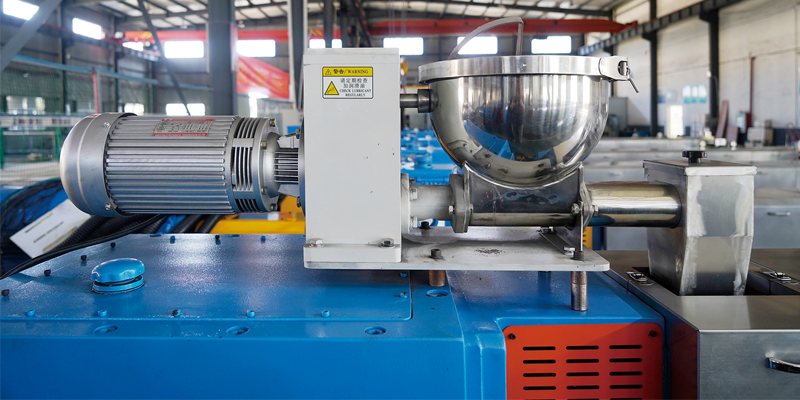
Me 16 nga tau o te wheako-a-ringa i roto i te hoahoa taputapu extrusion kirihou me te arotautanga, Kua tautoko ahau 300 nga kaihanga puta noa i Amerika Te Tai Tokerau, Uropi, me Ahia ki te kowhiri i nga punaha whangai tika mo o raatau raina extruder. Ko te whāngai volumetric ko te otinga tino whaihua mo 80% o nga tono tangohanga paerewa-whakarite te utu, pono, me te ngawari o te whakamahi i te wa e tuku ana i nga mahi whangai mo te tini o nga rawa kirihou. Kaore i rite ki nga kai whangai mate-i-taimaha e hiahia ana kia nui te haumi o mua, Ka tukuna e nga kaiwhangai volumetric he utu whai hua mo te tangohanga kaupapa whanui, ko te tino tika me te whakaputanga teitei ko nga whainga tuatahi Kaihanga Kaihanga Volumetric.
Ko te Kaiwhakarato Whakawhangai Volumetric he pai mo te nuinga o nga otinga whangai extruder, he iti te utu me te tino pai o nga ahuatanga whangai. Ka rite ki te maataki i nga waahi tukatuka kirihou puta noa i te ao, kua hangaia tenei momo kai hei kawe i te rahinga o nga rawa ki nga extruders (kotahi-wiri, māhanga-wiri, rua-waahi ranei) kaore he hiahia mo nga punaha ine taumaha uaua. Ko tenei ngawari ka whakamaoritia ki te iti o nga whakapaunga whakapaipai (30-50% iti iho i nga kai whangai mate-i-taimaha) me te tiaki iti, he mea pai mo nga kaihanga iti ki waenga-rahi, oma whakangao tawhē iti-nui, me nga tono kei te tino tika te horopeta (±0.1%) kaore e hiahiatia.
He hototahi ki nga mahi tangohanga tae atu ki nga kai whangai volumetric:
I enei tono, Ko te ±2% te tika o te rōrahi o te pūwhāngai he nui ake i te rawaka ki te pupuri tonu i te putanga extruder me te kounga hua, i te mea ko tana hoahoa pakari ka whakarite i te mahi pono i roto i nga taiao wheketere uaua (awhe pāmahana 0°C-45°C, taumata puehu ki runga ki te ISO 8573-1 Karaehe 4).
Ko te Te wheketere whangai Volumetric kei roto i te tiwiri mahanga iti, oko, me te motuka—e toru nga waahanga matua e mahi tahi ana ki te whakakore i nga wero whangai noa o te piriti, kapoka, me te tukunga koretake. Kaore i rite ki nga whangai volumetric kotahi-wiri (ka paheke nga rawa me te rere koretake), the twin-screw design creates a positive displacement action that ensures steady material movement from hopper to extruder feed throat.
A, no te tomo te rauemi ki te oko, ka huri noa te tīwiri e te roera whakaoho, Volumetric Feeder Wholesale e kore e pana noa te rauemi ki raro, engari ka whakaiti ano i te kato, kia ngawari ake te tuku, whakaora wa me te kaha, me te whakatau i te raru o te puhoi o te tukunga e pa ana ki te hua. The stirring roller (mounted at the hopper inlet) agitates bulk materials to prevent rat-holing and bridging—issues that plague single-screw feeders when processing low-flow materials like regrind flakes or filled compounds. This agitation, combined with the intermeshing twin screws, ensures that material is continuously conveyed to the extruder, even at low feed rates (5 kg/haora) or high rates (2000 kg/haora).
Zhuoyue’s volumetric feeders use a compact intermeshing twin-screw design (diameters 15mm-50mm) with customizable screw profiles to match material flow properties:
The twin screws are driven by a synchronized gearbox to ensure equal rotation speed, eliminating material trapping and shear heating (critical for temperature-sensitive materials like PVC).
The feeder barrel is machined from seamless carbon steel (ranei 304 stainless steel for food/medical-grade applications) with a smooth internal finish (Ra ≤ 1.6μm) to reduce material adhesion. The hopper is available in 5L, 10L, 20L, and 50L capacities, with a transparent polycarbonate option for visual material level monitoring. A vibratory base is optional for ultra-low-flow materials (e.g., glass fiber-filled PA pellets), further reducing clogging risk.
Volumetric feeders are equipped with IE3 premium efficiency motors (0.75kW-4.0kW) that meet EU Ecodesign Directive 2009/125/EC and US DOE energy efficiency standards. The motor drives the twin screws and stirring roller via a variable frequency drive (VFD), allowing precise speed adjustment (0-100 rpm) to match extruder output requirements. The control system features:
Zhuoyue offers a full range of volumetric feeders scaled to match extruder output, from lab-scale (5 kg/haora) ki te tauine-ahumahi (2000 kg/haora) hangahanga:
| Tauira | Mahanga-Tiu Diameter (mm) | Awhe Tere (rpm) | Te kaha whangai (kg/haora) | Te Mana Motini (kW) | Hopper Capacity (L) | Tika |
|---|---|---|---|---|---|---|
| ZYVF-15 | 15 | 0-80 | 5-50 | 0.75 | 5 | ±2% |
| ZYVF-25 | 25 | 0-90 | 20-150 | 1.5 | 10 | ±2% |
| ZYVF-35 | 35 | 0-100 | 50-500 | 2.2 | 20 | ±2% |
| ZYVF-50 | 50 | 0-100 | 100-2000 | 4.0 | 50 | ±2% |
Universal Specifications: All models operate on 220V/380V 50/60Hz single/three-phase power, weigh 25-85kg (depending on model), and feature a flange-mount design for direct attachment to extruder feed throats (compatible with 99% of global extruder brands).
Volumetric feeders offer the lowest total cost of ownership (TCO) of any industrial extruder feeding system:
For a mid-sized extrusion facility with 4 kai whangai, this translates to total cost savings of $15,000-$25,000 in the first year alone.
The simple mechanical design of volumetric feeders eliminates 90% of the failure points found in loss-in-weight systems (e.g., load cell drift, sensor calibration errors). Field data from 200+ Zhuoyue feeder installations shows:
The anti-clogging stirring roller and twin-screw design also reduce unplanned downtime from material jams – a common issue with single-screw feeders (responsible for 10-15% of extruder downtime in plastic facilities).
Volumetric feeders require no specialized technical knowledge to operate:
This is a critical advantage for manufacturers with high operator turnover or limited technical staff, as it reduces training time and human error.
Zhuoyue’s volumetric feeders handle a wide range of plastic materials without modification:
For food-contact or medical-grade applications, feeders can be configured with 304/316 stainless steel contact parts and FDA-compliant lubricants (meeting 21 CFR 177.1520).
A Texas-based PVC pipe manufacturer replaced aging single-screw feeders with 4 Zhuoyue ZYVF-50 volumetric feeders in 2024 ki te whakatika i nga kohungahunga whakaputa:
After installation of the ZYVF-50 feeders:
The plant manager reported: “The Zhuoyue feeders have been a game-changer – our operators no longer spend hours unclogging feeders, and our pipe quality has never been more consistent. We’ve been able to take on 2 new large customers thanks to the increased production capacity.”
Volumetric feeders are designed for plug-and-play installation:
Installation takes 1-2 haora mo ia kai whangai (no specialized tools required) – Zhuoyue’s on-site technical team can assist with multi-feeder installations for full production lines.
Calibration ensures feeding accuracy and should be performed for each new material type:
Calibration takes <30 minutes per material and can be performed by any trained operator (no external calibration service required).
Regular maintenance extends feeder life and preserves performance:
Zhuoyue provides a comprehensive maintenance manual with photos and step-by-step instructions (e wātea ana i te reo Ingarihi, Paniora, and German) for in-house teams.
A: Ae. Multiple volumetric feeders (1 for main resin, 1+ for additives/masterbatch) can be synchronized with the extruder PLC to maintain precise volume ratios (e.g., 95% PVC + 5% huinga matua tae). This is a cost-effective alternative to multi-component loss-in-weight systems for non-critical compounding applications.
A: Volumetric feeders perform best with free-flowing materials (kiato rahi 0.5-0.9 g/cm³) like virgin pellets. For low-flow materials (kiato rahi <0.4 g/cm³, e.g., rerind flakes), we recommend the short-pitch screw option + vibratory base to improve flow and maintain accuracy.
A: Tino. Zhuoyue’s ZYVF series is specifically engineered for recycled plastic processing – the anti-clogging stirring roller and twin-screw design handle regrind flakes/pellets with minimal jamming. We recommend the wear-resistant screw coating for recycled materials with high impurity content (e.g., dirt, kongakonga kongakonga).
A: Nga tauira paerewa (ZYVF-15 to ZYVF-50) whai wa arahi o 3-4 wiki. Whakaritenga ritenga (kowiri tira wahi whakapā, vibratory base, HMI control) rapua 5-6 wiki. Te whakaputa tere (2-te wa arahi wiki) kei te waatea mo te taapiri 15% utu.
A: Ka tukuna e Zhuoyue he raihana 2-tau mo nga waahanga miihini katoa (tīwiri, oko, motuka, pouaka taputapu) and a 1-year warranty on electrical components (VFD, control panel). Ka tukuna ano e matou nga whiringa whakamanatanga roa (3-5 tau) mo te utu taapiri, including annual preventive maintenance visits.
Mo te mutunga 16 tau, Zhuoyue’s volumetric feeders have been the go-to choice for plastic extrusion manufacturers seeking a reliable, cost-effective feeding solution. Whether you’re producing PVC pipes, PE sheets, or recycled plastic profiles, our feeders deliver consistent performance, minimal downtime, and maximum value – all backed by global technical support and a proven track record of success. Contact our sales team today to request a free feeder selection guide and quote tailored to your extruder’s specific requirements.