

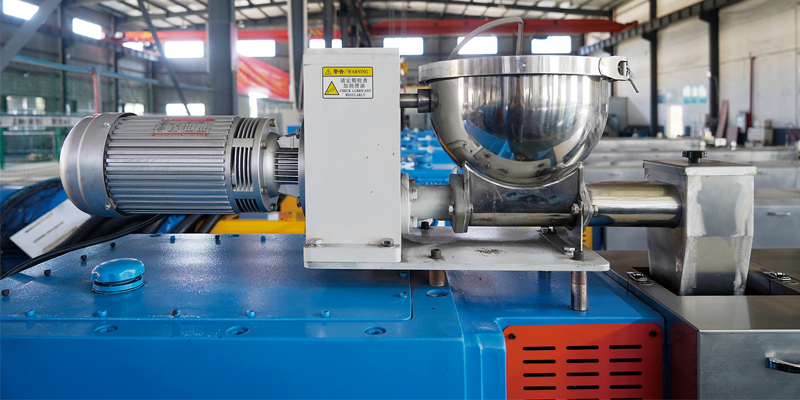
With 16 years of hands-on experience in plastic extrusion equipment design and optimization, I’ve supported over 300 manufacturers across North America, Europa, and Asia in selecting the right feeding systems for their extruder lines. The volumetric feeder stands out as the most practical solution for 80% of standard extrusion applications—balancing affordability, fiabilidade, and ease of use while delivering consistent feeding performance for a wide range of plastic materials. Unlike precision loss-in-weight feeders that require significant upfront investment, volumetric feeders offer a cost-effective alternative for general-purpose extrusion, where moderate accuracy and high throughput are the primary goals Volumetric Feeder Manufacturer.
O Volumetric Feeder Supplier is suitable for most extruder feeding solutions, it has low-cost and high-efficiency feeding characteristics. As a staple in plastic processing facilities worldwide, this feeder type is engineered to deliver a consistent volume of material to extruders (dun só parafuso, dobre parafuso, or two-stage) without the need for complex weight measurement systems. This simplicity translates to lower capital expenditure (30-50% less than loss-in-weight feeders) e un mantemento mínimo, making it ideal for small to mid-sized manufacturers, tiradas de produción de gran volume e baixa marxe, e aplicacións onde a precisión de dosificación axustada (±0,1 %) non é necesario.
Os alimentadores volumétricos son universalmente compatibles cos procesos de extrusión, incluíndo:
Nestas aplicacións, a precisión do volume do alimentador de ± 2 % é máis que suficiente para manter a calidade do produto e unha produción consistente da extrusora, mentres que o seu deseño robusto garante un funcionamento fiable en ambientes duros de fábrica (intervalos de temperatura 0°C-45°C, niveis de po ata ISO 8573-1 Clase 4).
O Volumetric Feeder Factory consists of a small twin screw, barril, and motor—three core components that work in tandem to eliminate the common feeding challenges of bridging, clogging, and inconsistent discharge. Unlike single-screw volumetric feeders (prone to material slipping and uneven flow), the twin-screw design creates a positive displacement action that ensures steady material movement from hopper to extruder feed throat.
When the material enters the barrel, the screw is simply rotated by the stirring roller, Volumetric Feeder Wholesale which not only pushes the material to the bottom, but also reduces clogging, making it easier to discharge, saving time and energy, and solving the problem of slow discharging affecting productivity. The stirring roller (mounted at the hopper inlet) axita os materiais a granel para evitar a perforación de ratos e as pontes, problemas que afectan aos alimentadores dun só parafuso ao procesar materiais de baixo fluxo, como escamas remoídas ou compostos recheos.. Esta axitación, combinado cos parafusos xemelgos entrelazados, garante que o material sexa continuamente transportado á extrusora, mesmo a baixas velocidades de alimentación (5 kg/h) ou taxas elevadas (2000 kg/h).
Os alimentadores volumétricos de Zhuoyue usan un deseño compacto de dobre parafuso (diámetros 15 mm-50 mm) con perfís de parafuso personalizables para que coincidan coas propiedades do fluxo de material:
The twin screws are driven by a synchronized gearbox to ensure equal rotation speed, eliminating material trapping and shear heating (critical for temperature-sensitive materials like PVC).
The feeder barrel is machined from seamless carbon steel (ou 304 stainless steel for food/medical-grade applications) with a smooth internal finish (Ra ≤ 1.6μm) to reduce material adhesion. The hopper is available in 5L, 10L, 20L, and 50L capacities, with a transparent polycarbonate option for visual material level monitoring. A vibratory base is optional for ultra-low-flow materials (p.ex., glass fiber-filled PA pellets), further reducing clogging risk.
Volumetric feeders are equipped with IE3 premium efficiency motors (0.75kW-4.0kW) that meet EU Ecodesign Directive 2009/125/EC and US DOE energy efficiency standards. The motor drives the twin screws and stirring roller via a variable frequency drive (VFD), allowing precise speed adjustment (0-100 rpm) to match extruder output requirements. The control system features:
Zhuoyue offers a full range of volumetric feeders scaled to match extruder output, from lab-scale (5 kg/h) to industrial-scale (2000 kg/h) production:
| Modelo | Twin-Screw Diameter (mm) | Speed Range (rpm) | Feeding Capacity (kg/h) | Motor Power (kW) | Hopper Capacity (L) | Accuracy |
|---|---|---|---|---|---|---|
| ZYVF-15 | 15 | 0-80 | 5-50 | 0.75 | 5 | ±2% |
| ZYVF-25 | 25 | 0-90 | 20-150 | 1.5 | 10 | ±2% |
| ZYVF-35 | 35 | 0-100 | 50-500 | 2.2 | 20 | ±2% |
| ZYVF-50 | 50 | 0-100 | 100-2000 | 4.0 | 50 | ±2% |
Universal Specifications: All models operate on 220V/380V 50/60Hz single/three-phase power, weigh 25-85kg (depending on model), and feature a flange-mount design for direct attachment to extruder feed throats (compatible with 99% of global extruder brands).
Volumetric feeders offer the lowest total cost of ownership (TCO) of any industrial extruder feeding system:
For a mid-sized extrusion facility with 4 alimentadores, this translates to total cost savings of $15,000-$25,000 in the first year alone.
The simple mechanical design of volumetric feeders eliminates 90% of the failure points found in loss-in-weight systems (p.ex., load cell drift, sensor calibration errors). Field data from 200+ Zhuoyue feeder installations shows:
The anti-clogging stirring roller and twin-screw design also reduce unplanned downtime from material jams – a common issue with single-screw feeders (responsible for 10-15% of extruder downtime in plastic facilities).
Volumetric feeders require no specialized technical knowledge to operate:
This is a critical advantage for manufacturers with high operator turnover or limited technical staff, as it reduces training time and human error.
Zhuoyue’s volumetric feeders handle a wide range of plastic materials without modification:
For food-contact or medical-grade applications, feeders can be configured with 304/316 stainless steel contact parts and FDA-compliant lubricants (meeting 21 CFR 177.1520).
A Texas-based PVC pipe manufacturer replaced aging single-screw feeders with 4 Zhuoyue ZYVF-50 volumetric feeders in 2024 to address production bottlenecks:
After installation of the ZYVF-50 feeders:
O director da planta informou: "Os alimentadores Zhuoyue foron un cambio de xogo: os nosos operadores xa non pasan horas desatascando os alimentadores., e a nosa calidade de tubos nunca foi máis consistente. Puidemos asumir 2 novos grandes clientes grazas ao aumento da capacidade de produción”.
Volumetric feeders are designed for plug-and-play installation:
Installation takes 1-2 hours per feeder (no specialized tools required) – Zhuoyue’s on-site technical team can assist with multi-feeder installations for full production lines.
Calibration ensures feeding accuracy and should be performed for each new material type:
Calibration takes <30 minutes per material and can be performed by any trained operator (no external calibration service required).
Regular maintenance extends feeder life and preserves performance:
Zhuoyue provides a comprehensive maintenance manual with photos and step-by-step instructions (dispoñible en inglés, español, e alemán) para equipos internos.
A: Si. Múltiples alimentadores volumétricos (1 para resina principal, 1+ para aditivos/masterbatch) pódese sincronizar co PLC extrusor para manter relacións de volume precisas (p.ex., 95% PVC + 5% masterbatch de cores). Esta é unha alternativa rendible aos sistemas de perda de peso de varios compoñentes para aplicacións de composición non críticas..
A: Os alimentadores volumétricos funcionan mellor con materiais de fluxo libre (densidade aparente 0.5-0.9 g/cm³) como pellets virxes. Para materiais de baixo fluxo (densidade aparente <0.4 g/cm³, p.ex., moer escamas), recomendamos a opción de parafuso de paso curto + base vibratoria para mellorar o fluxo e manter a precisión.
A: Absolutamente. A serie ZYVF de Zhuoyue está deseñada especificamente para o procesamento de plásticos reciclados: o rolo de axitación anti-obturación e o mango de deseño de dobre parafuso para triturar escamas/pellets cun mínimo atasco.. Recomendamos o revestimento de parafuso resistente ao desgaste para materiais reciclados con alto contido en impurezas (p.ex., sucidade, fragmentos metálicos).
A: Modelos estándar (ZYVF-15 a ZYVF-50) ter un prazo de execución de 3-4 semanas. Configuracións personalizadas (pezas de contacto de aceiro inoxidable, base vibratoria, Control HMI) esixir 5-6 semanas. Produción acelerada (2-prazo de entrega da semana) está dispoñible por un adicional 15% taxa.
A: Zhuoyue ofrece unha garantía de 2 anos en todos os compoñentes mecánicos (parafusos, barril, motor, caixa de cambios) e unha garantía de 1 ano en compoñentes eléctricos (VFD, panel de control). Tamén ofrecemos opcións de garantía ampliada (3-5 anos) por unha tarifa adicional, incluíndo visitas anuais de mantemento preventivo.
Por máis 16 anos, Os alimentadores volumétricos de Zhuoyue foron a opción preferida para os fabricantes de extrusión de plástico que buscan unha solución fiable., solución de alimentación rentable. Tanto se está a producir tubos de PVC, Follas de PE, ou perfís de plástico reciclado, os nosos alimentadores ofrecen un rendemento constante, tempo de inactividade mínimo, e valor máximo, todo respaldado por soporte técnico global e un historial comprobado de éxito. Contacte hoxe co noso equipo de vendas para solicitar unha guía gratuíta de selección de alimentadores e unha cotización adaptada aos requisitos específicos da súa extrusora.